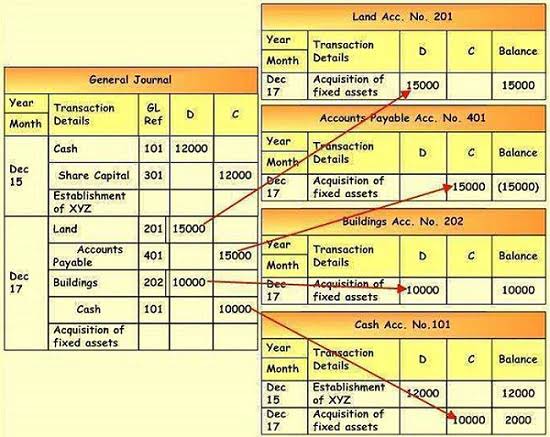
In single-entry accounting, when a business completes a transaction, it records that transaction in only one account. For example, if a business sells a good, the expenses of the good are recorded when it is purchased, and the revenue is recorded when the good is sold. This practice ensures that the accounting equation always remains balanced; that is, the left side value of the equation will always match the right side value. If a business buys raw materials by paying cash, it will lead to an increase in inventory (asset) while reducing cash capital (another asset). Because there are two or more accounts affected by every transaction carried out by a company, the accounting system is petty cash referred to as double-entry accounting.
Ledger Accounts
The debit entry increases the asset balance and the credit entry increases the notes payable liability balance by the same amount. On the income statement, debits increase the balances in expense and loss accounts, while credits decrease their balances. Debits decrease revenue account balances, while credits increase their balances. This equation means that the total value of a company’s assets must equal the sum of its liabilities and equity. In other words, if a company has ₹1000 in assets and ₹500 in liabilities, then its equity must be ₹500. If a company has ₹1000 in assets and ₹1100 in liabilities, then its equity would be -₹100.
- After recording the transactions, we now have a running record of all accounts, and hence a complete accounting system.
- For example, if you buy new equipment (an asset), you might either take on a loan (a liability) or spend cash from your account (reducing an asset).
- For example, when a company purchases inventory on credit, the inventory account is debited (receives the benefit), and the accounts payable account is credited (gives the benefit).
- Shaun Conrad is a Certified Public Accountant and CPA exam expert with a passion for teaching.
Recording transactions
Ledgers group related accounts together, creating a systematic structure that enables businesses to track and manage their financial activities. This hierarchical arrangement not only simplifies data retrieval but also facilitates the preparation of financial statements and the identification of errors or discrepancies. At the heart of double entry accounting lies the pivotal concept that every financial transaction has two distinct and inseparable effects. For every action, there is a reaction, and this duality ensures that the equation of assets equals liabilities plus equity remains consistently balanced. Double-entry accounting promotes accuracy by applying the principle that every financial transaction has equal and opposite effects on at least two accounts. In summary, double-entry accounting, with its foundations in assets, liabilities, debits, and credits, offers a robust and effective way to maintain accurate bookkeeping.
- It has made it easier to keep track of financial records, generate reports, and manage cash flow.
- You can always add more asset and expense accounts to your chart of accounts.
- Double-entry bookkeeping has been in use for at least hundreds, if not thousands, of years.
- It is important to detect and correct errors and fraudulent activities as soon as possible to maintain the accuracy of financial records.
Double Entry Accounting Mini Quiz:
The double-entry accounting system follows the principle of the accounting equation. Most accounting software automatically performs double-entry accounting behind the scenes. The early beginnings and development of accounting can be traced back to the ancient civilizations in Mesopotamia and is closely related to the development of writing, counting, and money.
Debits and credits
The benefit received by the business is equal to the benefit given, which in this case sums up to 1,000,000. Let us assume that a business purchases a building for 1,000,000, In this transaction, the business receives the ownership of the building and gives 1,000,000 to the seller. The Romans were the first to use a rudimentary form of double-entry bookkeeping, but it was not until the 15th century that the system was fully developed in Europe. The double-entry bookkeeping system has been refined over the centuries Medical Billing Process and is still widely used today. Despite a comprehensive approach and several benefits, the double-entry system also comes with some disadvantages. Suppose ABC takes a short-term loan with a maturity period of 3 months for a total amount of $ 50,000.
Single-Entry vs. Double-Entry Bookkeeping
The normal balance in such cases would be a debit, and debits would increase the accounts, while credits would decrease them. Once one understands the DEAD rule, it is easy to know that any other accounts would be treated in the exact opposite manner from the accounts subject to the DEAD rule. Each time you enter a transaction, record the debit and credit to the appropriate accounts. For example, if you buy office supplies with cash, you debit the Supplies Expense account and credit Cash. Managing payroll involves various expenses, tax withholdings, and liabilities.
The debits and double-entry accounting has two equal sides credits are tracked in a general ledger, otherwise referred to as the “T-account”, which reduces the chance of errors when tracking transactions. Double-entry accounting is a system where each transaction is recorded in at least two accounts. This method provides a more complete picture of a business’s finances and is typically used by larger businesses. Many companies, regardless of their size or industry, use double-entry accounting for their bookkeeping needs because it provides a more accurate depiction of their financial health.

Real accounts mean assets owned by a business such as a machinery, equipment, land, property, and so on. A sub-ledger may be kept for each individual account, which will only represent one-half of the entry. When Lucie purchases the shelving, the Equipment sub-ledger would only show half of the entry, which is the debit to Equipment for $5,000.

Balancing and the trial balance

Our team is ready to learn about your business and guide you to the right solution. Double Entry is recorded in a manner that the Accounting Equation is always in balance. In case of any confusion, please refer Accounting for Sales section for more thorough explanation of the accounting entries discussed above. Double entry accounting revolves around the idea that for every value given, there is a corresponding value received, and vice versa. However, it is only suitable for users with limited accounting requirements.